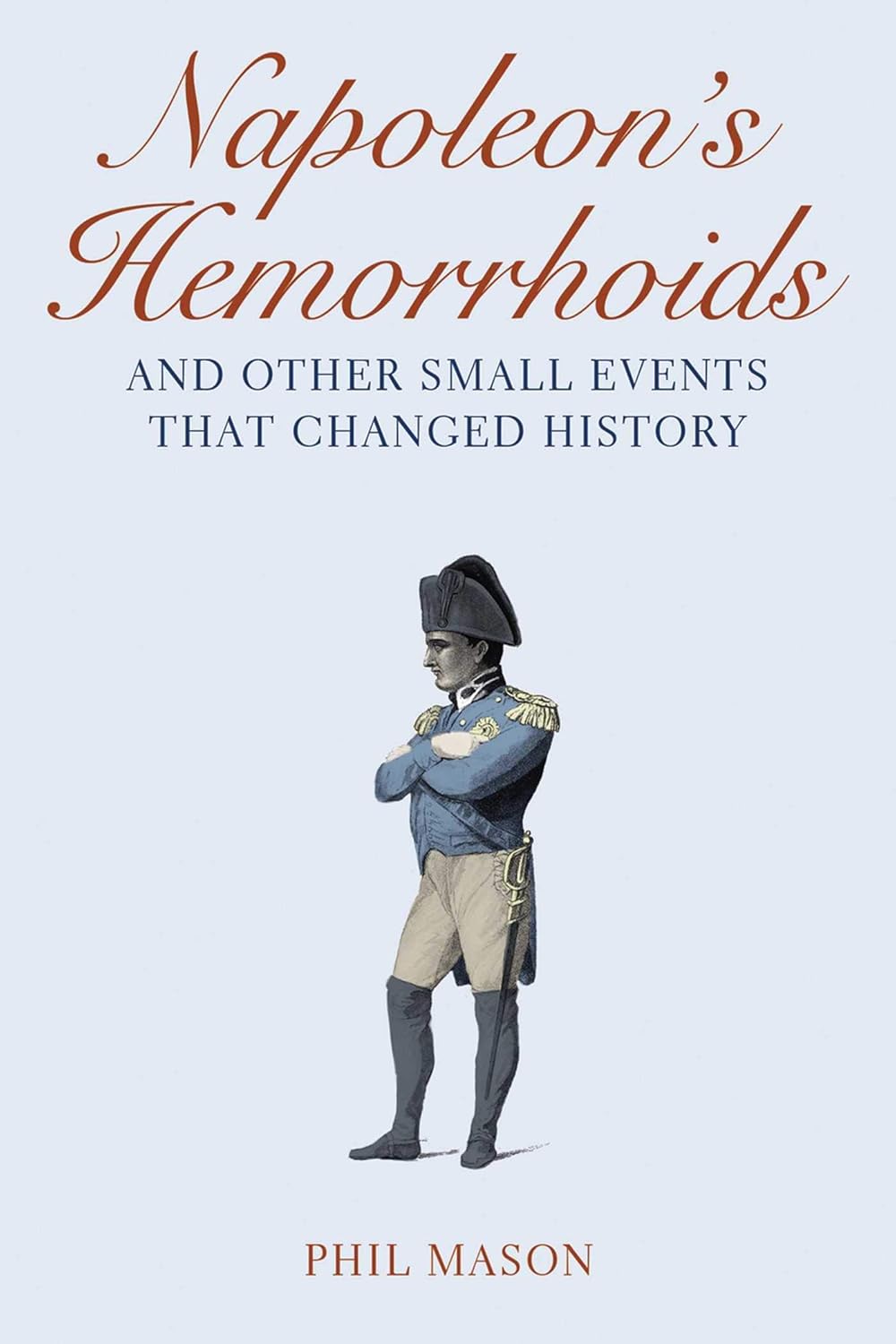
Hilarious, fascinating, and a roller coaster of dizzying, historical what-ifs, Napoleon’s Hemorrhoids is a potpourri for serious historians and casual history buffs. In one of Phil Mason’s many revelations, you’ll learn that Communist jets were two minutes away from opening fire on American planes during the Cuban missile crisis, when they had to turn back as they were running out of fuel. You’ll discover that before the Battle of Waterloo, Napoleon’s painful hemorrhoids prevented him from mounting his horse to survey the battlefield. You’ll learn that an irate blacksmith threw his hammer at a fox and missed, hitting a rock and revealing the largest vein of silver ever discovered, thus changing the finances of Canada forever. Interestingly, Charlton Heston was cast as Moses in The Ten Commandments because his broken nose made him look like Michelangelo’s famous sculpture of Moses. Finally, no one knows Einstein’s last words. They were in German, a language his nurse did not speak.
A treasure trove filled with fascinating anecdotes about the tiny ripples that created big waves in history, Napoleon’s Hemorrhoids is much more than just a trivial fact book; it is an astonishing historical-fate book revealing how our most famous incidents, best-loved works of art, and most accepted historical outcomes are simply twists of fate.
I’ll be very honest my friends: I wondered, and still do, to some degree, whether I should actually write a review about this book. First, because of the nature of the book itself and Second, because I retained so little of the book. Even now I can only recall a few of the things I “learned” from the book. But, after a while, I decided that perhaps the latter was a good enough reason alone to write this review, so let’s get into it.
As I mentioned in a post a couple of days ago, I have been experiencing serious Series Fatigue with a touch of Genre Fatigue (principally in the fantasy genre). So I took to my Audible account to find something relatively light and quick, and, most importantly, well outside the genre of fantasy (or speculative fiction altogether). I settled on Napoleon’s Hemorrhoids, figuring it was about as far from fantasy that I could get for a little palate cleanser. Unfortunately, outside of being a quick read, the book left me pretty disappointed and wanting.
The biggest problem was the formatting. Everything was, logically, separated into categorical chapters, which makes an abundance of sense. From there, however, the sense somewhat falls away. All the anecdotes were really just quick facts, some weren’t even “little events,” or strange occurrences as promised by the title, but normal everyday things. For example. In the blurb above, the fact that Einstein’s nurse didn’t know German and therefore did not understand his final words is mentioned. That is the entire fact. History was not changed because of this. Another event mentioned was the storm that derailed the Spanish Armada’s invasion of England. Call me pedantic, but a massive gale/hurricane is not a little event. But I digress. My point is the book is actually just quick individual paragraphs (sometimes just a single sentence) of facts that are not always what was promised.
Because of the organization of the book, the audio-recording FLEW by. The narrator sounded robotic at normal speed so I sped him up to 2x so he spoke at a normal speed and still the facts flew by with little information outside of the bare bones of the factoid itself. I retained very little information because I was given very little information to accompany and cement each fact. I feel like this book would be better suited to use as the basis of a trivia game as opposed to something to be read for any historical retainment value. If you like quick trivia and have a better memory than my ADHD-addled brain, by all means, snap this book up. I should interject that I actually love trivia and facts, but I felt like I was promised something different. Something with a little more meat and heft. Anyway, I would recommend reading it over the audiobook, however. You may have a better chance of retaining the information than I did.
 The Book Wench
Leave a comment