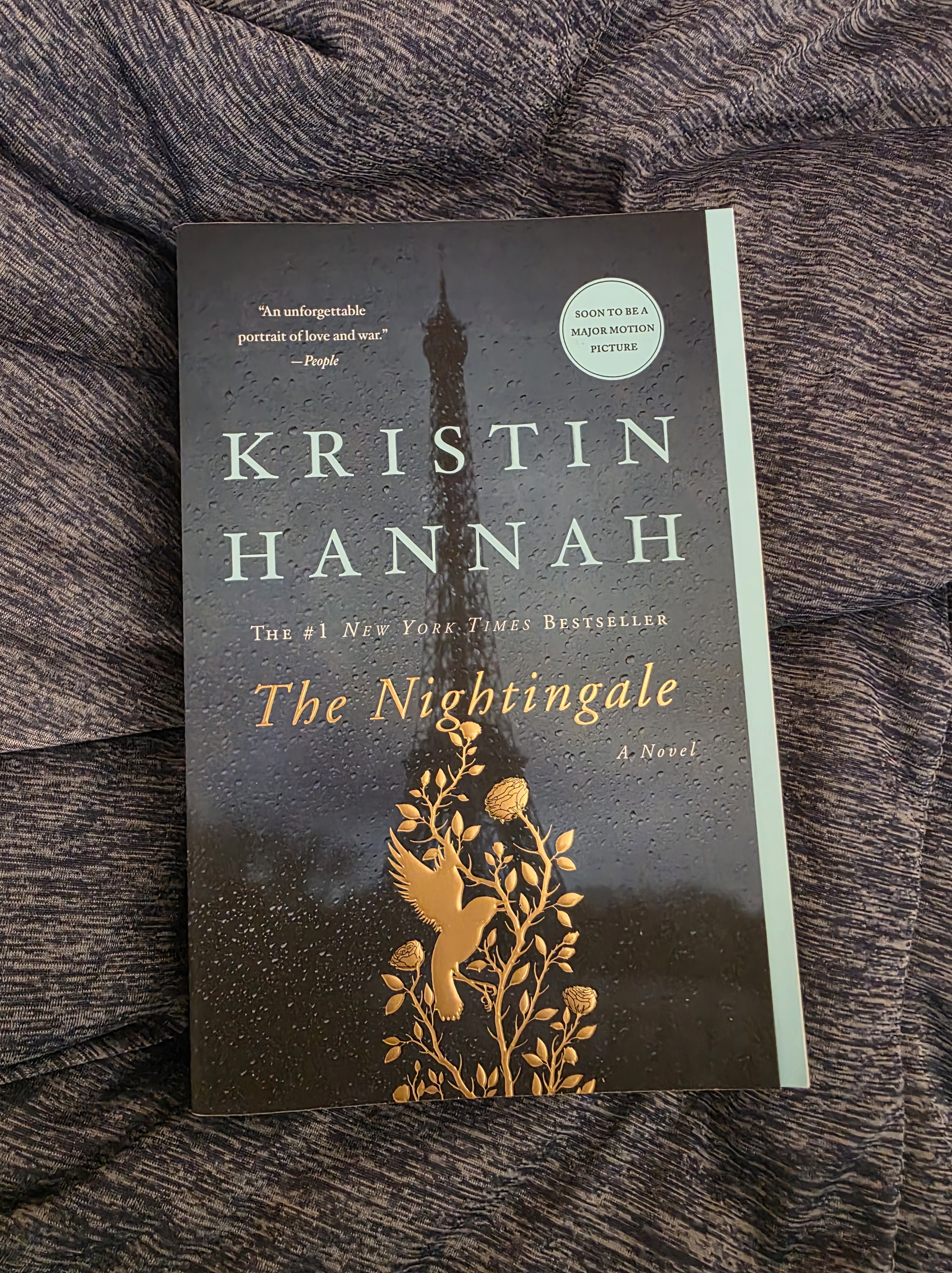
France, 1939 – In the quiet village of Carriveau, Vianne Mauriac says goodbye to her husband, Antoine, as he heads for the Front. She doesn’t believe that the Nazis will invade France … but invade they do, in droves of marching soldiers, in caravans of trucks and tanks, in planes that fill the skies and drop bombs upon the innocent. When a German captain requisitions Vianne’s home, she and her daughter must live with the enemy or lose everything. Without food or money or hope, as danger escalates all around them, she is forced to make one impossible choice after another to keep her family alive.
Vianne’s sister, Isabelle, is a rebellious eighteen-year-old girl, searching for purpose with all the reckless passion of youth. While thousands of Parisians march into the unknown terrors of war, she meets Gäetan, a partisan who believes the French can fight the Nazis from within France, and she falls in love as only the young can … completely. But when he betrays her, Isabelle joins the Resistance and never looks back, risking her life time and again to save others.
The Nightingale was a hard read. Not because of my disliking it in any way (I loved it) but because it dealt with such heavy subjects. Despite being well-acquainted with the history of France during WWII, reading about it through the eyes of a French citizen is different than being told facts by rote in a classroom setting. There is a graver depth to it, a nuance that you can’t shake. A melancholy that you cannot escape. Because of this, it did take me some time to complete the novel, but, again, it was not from lack of interest or anything. It was because Hannah did such an excellent job at portraying the devastating emotions and effects of one of the bleakest periods in human history.
There were times that I greatly enjoyed the dual-POV and other times when it frustrated me. The frustration was mostly because either the POV would change in the middle of a chapter and I would not realize it had changed until a paragraph in or so OR because the change was predicated on a cliff-hanger and I was dying to know what happened. But I know that the latter situation was intentional to build tension. Still, I was frustrated in those moments because my anxiety needed to know what happened. I don’t count these frustrations against the book because 1: context clues should have told me the POV changed and 2: again, the changes were to build tension.
I really enjoyed both characters and how different they were from each other. Many times, multiple POV books fail in the character building and voice, and the different characters often sound the same. This was not the case in The Nightingale. Vianne and Isabelle held two very distinct voices and points-of-view and I really appreciated how well Hannah was able to exert this.
This was one of those books that I sincerely wished that what I knew about history was wrong. Several historically-accurate events occurred in this book and it hurt my heart to have to watch them unfold knowing how they would end. Not that anything was predictable or anything, but when you have studied WWII enough in school, you can kinda get an idea where historical fiction is going and what events will happen from context and prior knowledge. I’m trying to be vague here to prevent any sorts of spoilers. Just understand that things portrayed in this book DID happen in real life even though these characters are not based on any particular people.
I really appreciate the research and trouble Hannah went through to produce such a lovely book. Sure it had its faults, what book doesn’t? I am sincerely impressed at the span of the novel and how engaging it was. I can honestly say if I wasn’t dealing with so much with school and other things going on, I would have finished this much quicker than I did.
I would recommend this to anyone who loves historical fiction, strong women, and tales of courage. I would caution, however, not to read the book before bead as it can leave you up half the night ruminating on the past and, while it may not give nightmares, it can be quite a depressing read at the end of the day. Also, I do recommend the audiobook if you are familiar with French. If not, some of the French phrases may be confusing or too fast. I took French many years ago and still chose to read immersively (audiobook while also reading the physical copy) so that I could catch all the French and pause if I needed to look something up.




Leave a comment