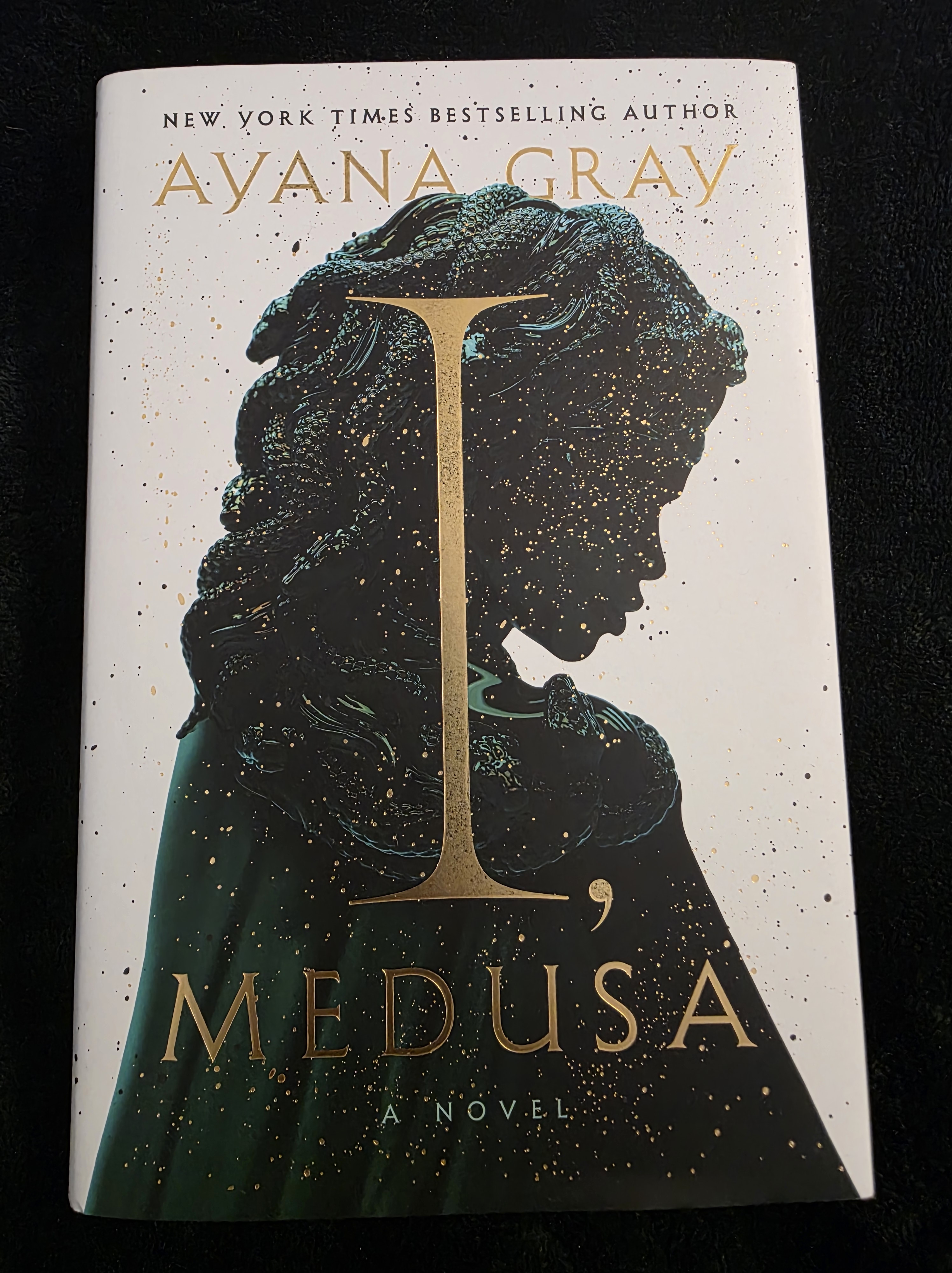
Meddy has spent her whole life as a footnote in someone else’s story. Out of place next to her beautiful, immortal sisters and her parents—both gods, albeit minor ones—she dreams of leaving her family’s island for a life of adventure. So when she catches the eye of the goddess Athena, who invites her to train as an esteemed priestess in her temple, Meddy leaps at the chance to see the world beyond her home.
In the colorful market streets of Athens and the clandestine chambers of the temple, Meddy flourishes in her role as Athena’s favored acolyte, getting her first tastes of purpose and power. But when she is noticed by another Olympian, Poseidon, the course of Meddy’s promising future is suddenly and irrevocably altered.
When her locs are transformed into snakes as punishment for a crime she did not commit, Medusa must embrace a new identity—not as a victim, but as a vigilante—and with it, the chance to write her own story as mortal, martyr, and myth.
If you were a Mythology kid like me, you know the story of Medusa. A cruel, snake-haired gorgon that can turn humans to stone with one searing look. But what if the stories are wrong? Or, rather, what if they are only right in some areas, but wrong in others. What if Medusa was really kind, intelligent, innocent?
Gray’s I, Medusa makes this question a reality. Starting back before Medusa was the gorgon we all know, Gray has furnished a persona behind and beyond the stories of snakes and stone. Medusa has become, in a whole new way, someone that readers can understand and empathize with. She was, after all, just a young girl.
I really liked Gray’s expansion on the Medusa myth, which was otherwise just a footnote in the voluminous collection of Greek mythology. She gives readers a new understanding and empathy for a young , mortal girl who is just trying to make her way in an immortal world. Medusa, Meddy to those that love her, tried her best to do the right thing but those much older and more powerful than her exerted control over her in ways that she couldn’t hope to understand until it was far too late.
The only thing I would have changed is I would have aged Medusa up some and I would have made the book longer. So much happens in a comparatively few pages that some things feel slightly rushed. I definitely think the book would have benefited from another 50 – 100 pages of story line. Plus, I would have loved to see more of Medusa after she became a gorgon. The blurb gives it away (I know, I know, it’s common knowledge but still) on the back but then it doesn’t happen until three-fourths of the book is gone. Other than that, I really felt that Gray did a superb job fleshing out Medusa’s character; her wants, her needs, her desires, and, yes, her purpose. I wish the ending could have been different, but alas we all know how the myth ends.
 The Book Wench
Leave a comment